
Learning to love Dvorak in Heidelberg
This semester we have been working on Dvorak's 9th Symphony, "From the New World", alongside Mussorgsky's "Night on Bare Mountain" and Bruch's Violin Concerto (no use putting any numbers there; he doesn't seem to have written anything else worth performing). We recently had a rehearsal weekend, immersing ourselves in music, and our first two concerts, successfully dispatched in Langenselbold (no, I had no idea, either) and Freiburg. Tomorrow night is our final, crowning concert in the Heidelberg Stadthalle.
I want to write a little bit about the Dvorak. For me, it's easy to dismiss - it's popular, for a start, which always makes me suspicious - and even as I tried to disregard its popularity, the piece never seemed to have anything of interest to say to me. It has its famous tunes and that's it; a pretty face with not much behind it. However, sitting at the back of the orchestra alongside the other trombonists and the poor tuba (who only has 14 notes to play in the whole piece), I have been learning to appreciate the piece, certainly to admire it, possibly, at times, conditionally, to love it.
That word 'learning' implies a process and indeed it took a while for me to feel at all involved in the piece during rehearsals, even though there's enough for the trombones to play (except in the third movement, where the trombones are inexplicably tacet - perhaps Anton didn't trust us to be sufficiently fleet of foot; or perhaps he simply didn't trust us to successfully find all of those repeats).
How could I not be involved in a piece that I am playing? It's a good question and the answer has two components - the physical / technical aspect of playing, and the emotional.
Physically, of course I was involved. There are several themes that the trombones play and - more difficult - lots of stabs to hit successfully. I was working on my technique, getting the breathing right, tweaking the tuning, trying to listen in to my colleagues to make sure we were playing as a section. Oh - and of course trying to play the right notes most of the time.
Through all of this, I didn't really have time to experience the piece. It had some tunes and some trombones.
Emotionally, we didn't connect for a long time, the piece and I. Maybe it was the overall lack of dissonance in the overall outlook, the almost saccharine positivity in the piece that discouraged me from investigating further. I certainly identified more strongly with the Kabalewsky and the Roussel that we played in previous winter concerts. Whilst the Dvorak certainly contains many little clashing details embedded throughout the piece to give it that certain frisson every piece of music needs, the overall impression was of musical platitudes that have become somewhat cliched.
Historically, Dvorak wrote the piece during a three year long sojourn in America (1892-1895), where he encountered and revelled in its musical and natural diversity. He was inspired to write a classical symphony that whilst not specifically including American elements, certainly painted a picture of a voyage, wide open plains, dance and returns to source. There is a human element in there that is American-tinged, leading to the critics' and theorists discussions about the nature of the songs - American or slavic.
Dvorak himself denied the presence of any American idiom in the piece, but I feel it does bubble forth with a visitor's joie de vivre. The perennial problem with incorporating traditional songs of whichever background is that those songs were meant to be sung, those rhythms danced to, not stuffed into a symphonic wad of cotton.
The significance of Dvorak's sojourn in New York stems from his assertion that the Americans should really develop their own classical language. The Americans we're hungry for confirmation of their place in the world, Europeans were thirsty for impressions of this New World, so its success was guaranteed and justified.
As with people, so with music; give yourself some time to get beyond the superficial and you will find much to admire. Such listening is hard work, and requires practice. I currently do not listen to nearly enough classical music, mostly, I suspect, because I do not train myself to do so, nor grant myself the time to do so. Time to try again, I think!
So - do I really love the Dvorak? Actually, no. But I can admire it and that's a step foreward.
ps, boredom in music is of course not an uncommon problem, but the reasons behind what makes a piece dull are still remarkably difficult to describe.
My Marathon
Where does that stand in relation to the best runners? Well, the best in our group ran it in 19 minutes, and he was 200th or so. I was 2500th, give or take, and there were around 12000 participants, so I didn't do too badly. I definitely felt fitter than the previous two times, and I had more energy.
Energy was the biggest realisation from 2010. That year I had trained reasonably well, but I made the mistake of eating nothing other than an energy bar from lunchtime. This year I ate well at lunchtime, but kept munching at various intervals (I was at work, it being a Wednesday). I also made sure that I was well stocked for the bike ride from Heidelberg Pfaffengrund, where I work, to the Hockenheim Ring.
2011 was also my first "race" with the Terra Plana Evo "barefoot" running shoes. These have transformed my running. From clomping around in chunky Asics via Nike Free to the Evos, my feet have become steadily lighter and more flexible. My achilles tendon did receive a hard workout that points to potential for improvement, but basically I am a convert to barefoot running, landing on the front to middle of the foot rather than on the heel.
Naturally, I received a few comments about them, but mostly interested ones rather than snide.
Since that run, I have felt freed up to get back onto my various bikes, but the warm feeling of good intent is there, the thought in the back of my mind that a half marathon would be on the cards. But can I devote sufficient time to running rather than music or biking? That remains to be seen.
Energy considerations
My stance on energy is an open one: I am for a mix of available technologies.
- Oil will remain a key component of transportation energy for years to come
- Coal should be wound down (very slowly)
- Gas and shale gas are interesting agents for energy balancing
- Nuclear should be the key base energy driver
- Renewables should be part of the mix but should nor cannot become dominant sources
- Local energy (on houses or in communities) are interesting distractions from the energy requirements of whole countries
- Efficiency drives are necessary (and result in fascinating technological challenges in themselves) but should not return us to the dark ages
I wish...(trombone version)
I wish...
somebody had taught me how to breath much earlier; how important the body is to playing; that the lips are the gateway to the trombone, but that the work is done much earlier; how important the mind is to playing; how important relaxation is to playing; that the instrument should be brought up to my posture, not the other way around.
These things I now realise and know intellectually, but they are not innate.
Does it matter? Well, I am where I am with orchestra, and I don't necessarily need to be at a higher level... But I do dream of it sometimes. We can all dream.
A Night flight and a right fright
This week I ended up on a more unusual trip, to Dacia in Romania, to discuss some issues that they have been having in production. It was to have been a relatively relaxed journey, flying to Bucharest from Frankfurt airport early in the afternoon to stay in an airport hotel until my colleague from Turkey arrived early the next morning. Alas, though, systems happened.
We have the Egencia travel booking system at work; it is the business version of Expedia. Egencia turned out to be a nightmare for rapid turnaround travel as it has an - in itself eminently sensible - approval system built in. The problem is that these approvals need to be completed within a certain time, presumably in order to protect us all from monstrous price rises as the flight date nears. As soon as I had understood the need, I booked my flights on Friday afternoon. The approval deadline (written in very small letters in the confirmation email) was set for 20:00 that evening, when my manager and his boss were unlikely to be reading emails. The same happened on Monday, as the pair were out of the office. When it came to my flight on Tuesday, I thought that it had been confirmed, as Uwe had submitted his consent; but I discovered when I arrived to collect my eTicket - no ticket. My seat had been cancelled.
So, following a frantic round of internet bookings, phone calls and awaiting confirmation, I ended up on the late flight to Bucharest. On that flight over clouds lit by a full moon we passed a thunderstorm in the distance; the flashes of light within that dark mass of cloud were awe inspiring. We landed uneventfully at a quarter to midnight.
Bucharest airport has a new terminal that is perfectly inoffensive, but the signage is terrible. When I asked the infodesk how to get to my airport hotel, they sent me down a flight of stairs and a ramp into a dark car park occupied by an off duty, wide-boy taxi driver who convinced me to part with 20 Euros (the smallest note I had at the time) for a 2 minute ride to the hotel and, in the meantime, proceeded to tell me how insignificant 20 Euros was to me, especially as the company would pay for it, how the French were so arrogant, the Maroccans working for Dacia even more so...
My room was fine, though blighted by that most east european of curses, the endlessly barking and yapping dog outside. It reminded me of my earlier 'adventures' in Liberec but I was at least tired enough to get to sleep relatively quickly this time around.
The next day I met my colleague Ilker at the airport and we found the taxi that he had pre-arranged. It was an ageing Dacia Logan that took us lumpily (with noticeable wheel wobble) through an ageing, shabby Bucharest suburb onto the motorway. Half way along that obviously European money edifice, the taxi was suddenly surrounded by a cloud of black smoke and then white steam, the engine revved out of control, we stopped on the hard shoulder and got out to survey the damage.
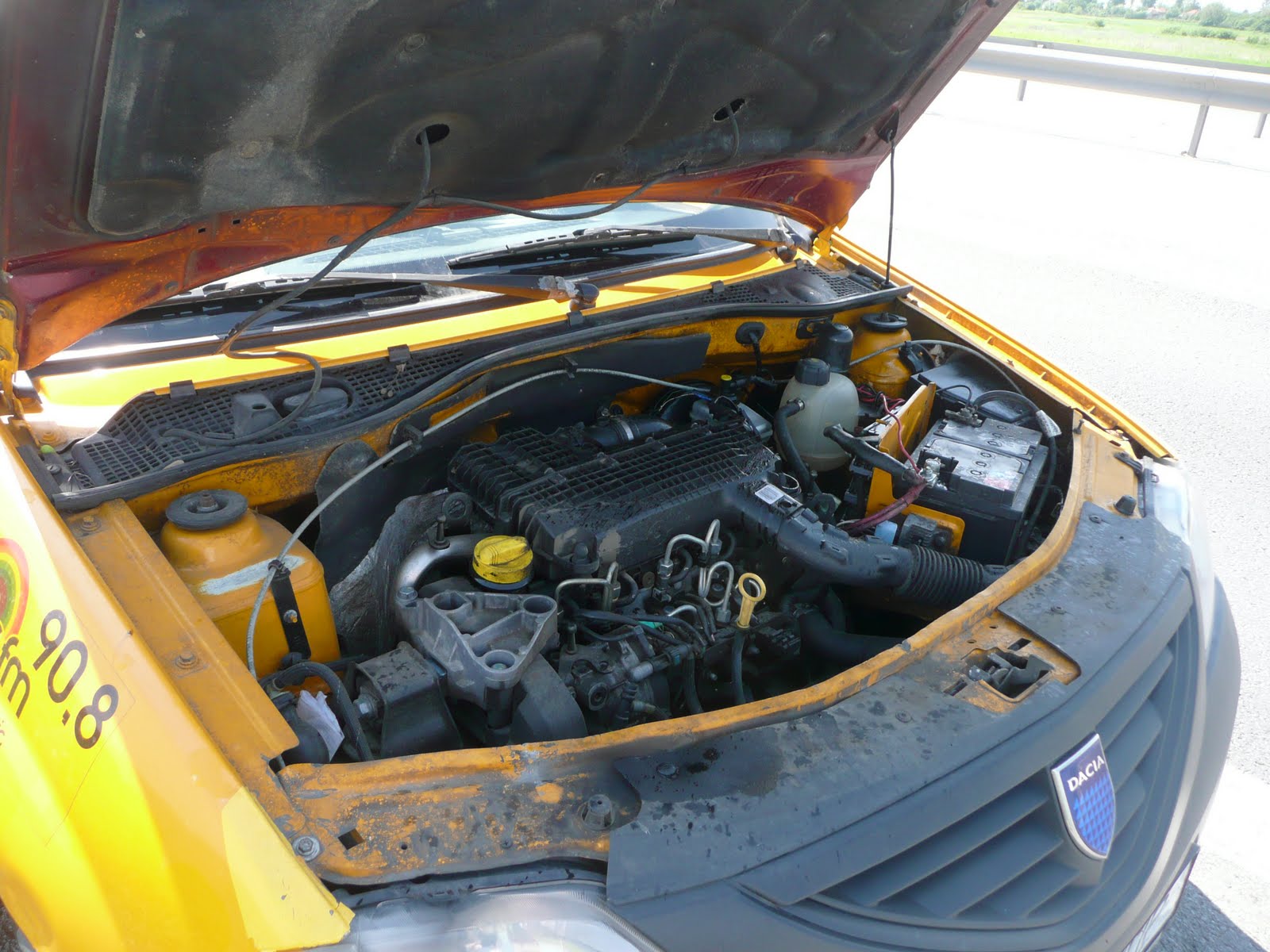
The engine was obviously not going to restart, despite the taxi driver's best efforts, so he started to make some phone calls. He initially offered a replacement taxi, but that, too, would have taken 45 minutes to get to us. Instead, he started to wave the traffic down. Astoundingly, within a few minutes a van transporting another (new) Dacia on its flat bed stopped and agreed to take Ilker and I to Pritesti, a town near to Mioveni which was our ultimate destination (well, my ultimate destination was home, but I couldn't possibly write that in LinkedIn). We were met there by another taxi and finally we arrived at Dacia.
We were offered a small coffee.
The meeting wasn't terribly effective as our customers didn't seem to have the faintest idea of what we were talking about; which meant that they would not change their view that we were at fault for a particular issue. However, when I pointed out that there was no evidence whatsoever that what they were experiencing was linked in any way to our parts, they seemed to go a little bit quieter still.
I got home again, in the end and thanks to the worst "quiche lorraine" on the planet courtesy of a certain large German airline, I even arrived with a little bit of energy to spare.
Blogging from a mobile phone
So, with me swyping this entry on a mobile phone, can I do justice to the artistic endeavour? Surprisingly, yes. Whilst it is more difficult to see the overall picture or flow of what is being written, and more care is required for the input itself, if I can take time and care over it, saving it, re-reading it, tweaking it, then there is no reason for this document to end up qualitatively different to a blog written with a fountain pen and paper.
I don't subscribe to the view that the care required for input amplifies the care taken in pre-selecting the word about to be written. Much more important is having the time available to concentrate on the content and avoiding distractions; even better than merely time is multiple times.
The factor that most limits blog entries such this on my Motorola Defy is fatigue. It a strain on the eyes to focus on such a small screen, it's a strain on the wrists holding the phone in such a way as to facilitate tapping or swyping, and on the shoulder. So in the end, this entry may end up being shorter than a version tapped out on a keyboard - but that is not necessarily a bad thing.
And so ends this entry, if not the experiment.
A relevant poem
I came across this poem whilst researching for Diversions Manifold (research meaning the desparate search for inspiration for the name).
But yield who will to their separation,
My object in living is to unite
My avocation and my vocation
As my two eyes make one in sight.
Only where love and need are one,
And the work is play for mortal stakes,
Is the deed ever really done
For heaven and the future´s sakes.
—Robert Frost, Two Tramps in Mud Time, st. 9
An Introduction
I to do too many things without devoting sufficient time to any one of them to become particularly good at it. Business, engineering, playing trombone, biking, singing, being a Dad, being a husband - and now blogging. So why should I harbour this conceit of publishing my thoughts? And why should you want to read them?
The answer to the first is fairly clear - I want to force myself to think again, something that I have not truly done since university. Egotistically, I want to push the results of these thoughts onto the web in order to force myself to find the right words, and to get as close as I can to a truth, however limited.
To the second question - why should you read this - I hope you have the answer. My hope is that some of what I write strikes a chord of recognition, a feeling of “Mitmensch” - being related in this form of humanity - and that it creates a little frisson of expectation that more is to come. Perhaps we share some interesting thoughts, perhaps we’re poles apart.
What I write should be well considered; I don’t want to waste any of our time as, I know all too well, it is spread far too thinly. What little we have should taste, sound or feel good.
Finally, I view it as a short history of who I am in an intellectual sense. If they are interested, maybe at least my daughters will browse through this blog (if it still exists) in the future to find out what complexities drive or at the time drove their otherwise boring old Dad.